

FRAMEWORK
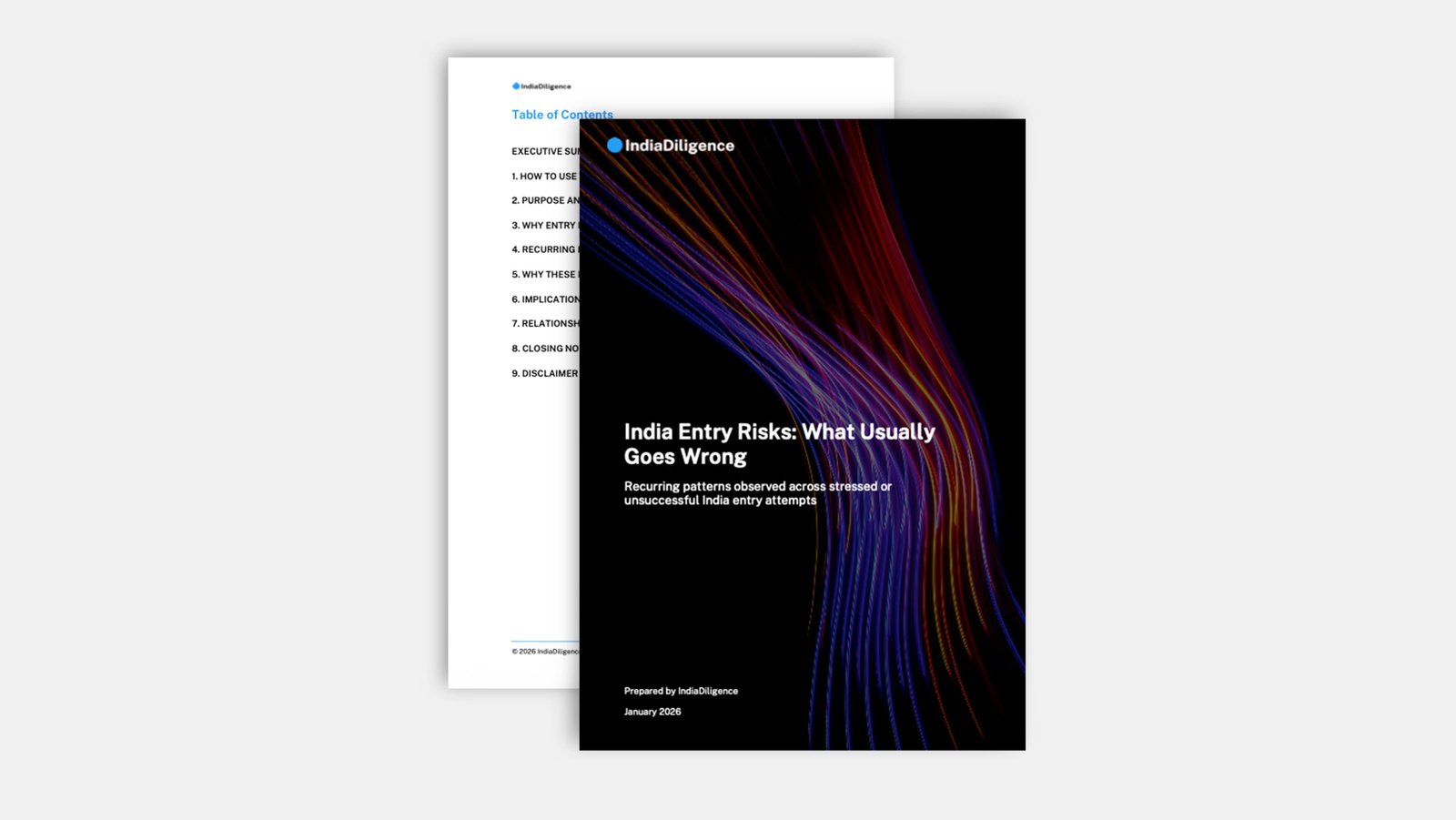
India Entry Risks: What Usually Goes Wrong
A pattern-based brief on recurring failure dynamics in India market entry.
Introduction
Many India entry failures do not stem from poor intent, weak capability, or insufficient ambition. They arise because structural risks are systematically misjudged — often masked by early momentum, positive signals, or confidence derived from initial progress. The India Entry Risks: What Usually Goes Wrong brief distils recurring patterns observed across stressed or unsuccessful India entry attempts. It is designed to help decision-makers recognise how and why entry risk accumulates — before consequences become difficult to reverse. This brief is intended to sharpen early judgement, not to diagnose outcomes after the fact.
What This Brief Is
This document is a pattern-based risk orientation brief, focused on how India entry typically fails in practice. Specifically, it is:
- A structured overview of recurring India entry failure patterns
- A tool for surfacing non-obvious risk dynamics early
- A companion to structured decision frameworks
- A reference document for boards and senior executives
- A pre-commitment aid designed to challenge false confidence
The brief focuses on structural tendencies, not individual cases or outcomes.
What This Brief Is Not
To avoid misinterpretation, this brief is not:
- A case study compilation
- A sector performance or market opportunity analysis
- A critique of individual companies or entry attempts
- A recommendation to proceed or not proceed
- A substitute for legal, regulatory, or commercial diligence
It is intentionally scoped to highlight how risk manifests, not to prescribe responses.
How the Brief Works
The brief identifies and explains a set of recurring failure patterns that consistently appear across stressed India entries, including:
- Early momentum masking structural risk
- Partner dependency becoming entrenched
- Capital becoming irreversible earlier than expected
- Management attention underestimated post-launch
- Regulatory sequencing misjudged
- Reputational exit cost underestimated
Each pattern is presented as a structural dynamic, not a deterministic outcome. The emphasis is on recognition and prioritisation, not avoidance.
Applicability Across Sectors
This brief is intentionally sector-agnostic. While operating models, regulatory environments, and commercial structures differ, the risk dynamics described here do not depend on sector characteristics. What varies by context is:
- Which risk pattern becomes dominant
- How quickly consequences accumulate
- When irreversibility emerges
The brief is designed to surface these dynamics without modification, allowing the patterns to be applied across different entry structures, operating models, and organisational contexts.
Who This Brief Is Designed For
This brief is designed for individuals and teams involved in early-stage India entry consideration, including:
- Boards and investment committees
- CFOs, General Counsel, and senior executives
- Corporate development and strategy teams
- Founders and owner-operators
- Advisors supporting market entry evaluation
It is most valuable before partners, capital structures, or public commitments are finalised.
What You Receive
Your purchase includes:
- A downloadable, professionally formatted PDF
- A structured overview of recurring India entry failure patterns
- Clear explanation of why these risks are predictable
- Guidance on how early decisions amplify or defer consequences
- Context on how the brief relates to decision frameworks and partner evaluation
Licensed for internal use within a single organisation, including board and investment committee circulation.
How This Is Typically Used
Most organisations use the brief to:
- Challenge confidence derived from early positive signals
- Surface risks that do not appear immediately or explicitly
- Frame internal discussion before formal evaluation begins
- Prepare decision-makers for structured framework application
- Revisit assumptions as entry conditions evolve